

This article emerges from "Action & Impact: A Cancer Care Initiative," a project in Ethiopia, funded by The Pfizer Foundation. Partners: the Ministry of Health-Ethiopia, the Clinton Health Access Initiative, and Innovations in Healthcare.
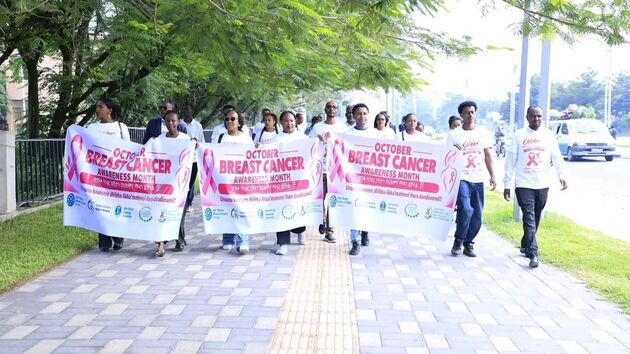
Photo, above: Community leaders, health professionals, and partners march with the Breast Cancer Awareness Month banner at the campaign launch in Hawassa.
Breast cancer is far easier to treat when it is found early. Yet in many communities, people stay silent about a lump or other changes because of fear, stigma, cost, or distance from a health facility. Some believe the disease is a curse. Others assume nothing can be done.
During this year’s October Breast Cancer Awareness Month, the "Action & Impact" project ran a three-week campaign across five locations, anchored by hospital events at each. We engaged more than 600 people directly through in-person events and reached an estimated 1M+ indirectly through media and broader outreach. In total, 2,116 women took the concrete step of being screened, and 102 were referred for further investigation. The campaign reinforced an important lesson: trusted community voices can help challenge fear and stigma, while accessible screening and clear referral pathways create opportunities to turn awareness into action.
The campaign in numbers

How we did it
1. Trusted leaders opened the conversation
Faith and traditional leaders spoke about breast health in worship spaces and community gatherings, challenging the idea that breast cancer is a curse.

Religious and traditional leaders offering blessings and leading a health dialogue in Harar.
2. Clinicians and panels gave plain answers
Oncologists and clinicians explained warning signs, early detection, and treatment in the local language at hospital sessions. Panel discussions put doctors, survivors, and community leaders on one stage, so people could ask frank questions and get direct answers.

Regional Health Bureau leadership, Hospital Leadership, senior physicians, religious leaders, survivor group leader, CHAI representative during official launch of the campaign.
3. Music and media reached beyond the venues
Road walks with marching bands took banners, music and energy into the streets, reaching people who would never attend a seminar. Loudspeakers, TV, radio, and social media carried our messages into neighborhoods and markets, and well beyond the event venues.

Marching bands and community members lead a unity walk in Harar City, Hararri Region.
4. Survivors shared their stories, and screening gave people a way to act
Survivors shared their stories and showed what life after diagnosis and treatment can look like. Every journey is different. Free on-site screening gave people an immediate way to act. Women and men who volunteered were examined, and anyone needing follow-up was referred.

Volunteers at a screening event, Dessie Comprehensive Specialized Hospital, Amhara Region.
A closer look at referrals
Of the 2,116 women screened from October 10–20, 2026, 102 (4.8%) had an abnormality identified and were referred for further investigation. The other 2,014 had no abnormality identified. A referral was not a diagnosis. It meant that a finding needed confirmation, and many findings turned out to be benign.

What we learned
- Trusted voices change minds. People listen to leaders, clinicians and survivors they already know.
- Timely diagnosis and treatment matter. Regular self-checks and prompt clinic visits help people get diagnosed and begin treatment sooner.
- It is a disease, not a curse. Publicly debunking myths made essential health conversations possible.
- Action must follow awareness. Free screening and clear referrals turned information into concrete action: 2,116 women screened and 102 referred for further investigation.
What happens next
The campaign has ended, but the work continues. We are committed to following up with all 102 referred women to support their next steps toward confirmation and care, keep leaders and survivors engaged as advocates, and find new ways to bring screening closer to those who need it most.
Know your body. Talk about it. If you notice a lump or any other change in your breast, don't wait; visit a health facility. Early detection saves lives. Share this post with someone who needs to hear it.
Our deepest thanks go to the partner hospitals, religious and traditional leaders, oncologists, survivors, performers, volunteers, media partners, donors and supporters. Together, we are helping more women find breast cancer early.
* Estimated 1 million indirect reach is based on the catchment population of each region, considering potential exposure to breast cancer awareness messages disseminated through regional TV and radio broadcasts, town loudspeaker announcements, and social media platforms managed by regional and district health offices.