
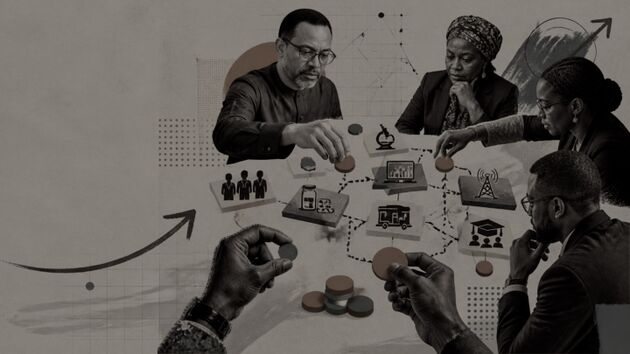
AI is attracting new attention—and significant new investments—across global health. That momentum creates real opportunity, but technology alone will not improve health outcomes. Introduced without trusted institutions, sound policy, usable evidence, sustainable financing, and the capacity to integrate new tools into existing services, AI can deepen fragmentation and widen disparities rather than solve them. The article argues that countries need more than funding for a growing menu of AI applications. They need durable, country-owned mechanisms to compare those tools with one another and with other health priorities, decide what to introduce and when, and determine how promising approaches can be financed and sustained. AI can strengthen public judgment by making evidence and tradeoffs more visible; it cannot replace the people and institutions accountable for making those choices.
Authors: Heather Lanthorn, Joao Ricardo Nickenig Vissoci, Krishna Udayakumar
Key Takeaways
- Accelerating AI investment amid shrinking health aid creates new opportunities and new challenges. While new commitments are promising, they are multi-year investments that depend on rapidly eroding health systems and a smaller workforce.
- Country-aligned investments can still create silos. Governments must integrate donor-funded AI investments into a sovereign agenda, national plans, and budgets—and retain the authority to redirect, sequence, or decline them.
- AI tools will make evidence more accessible and choices more plentiful; humans must still make tough decisions. Governments need pipeline visibility and durable decision mechanisms to compare AI tools with one another and with other health priorities. AI can strengthen public judgment; it cannot replace the people accountable for exercising it.
- AI investments must strengthen long-lasting mechanisms ("LLMs") for decision-making. Funders should invest in decision capabilities alongside the tools themselves, and governments must retain the authority to direct or decline investments according to national priorities.
I. Introduction
Many of the most visible new AI investments in global health focus on frontline applications—clinical decision support, screening, and care delivery. These tools could help overstretched health workers do more as health aid contracts. They also depend on those same workers, functioning systems, and ongoing financing. As the number of tested tools and large language models (LLMs) expands, countries need another kind of “LLM”: long-lasting mechanisms for comparing AI applications with one another, with other health products, and with competing demands on the health budget; deciding what to introduce and when; and planning how to sustain it. Funders can strengthen these country-owned processes, including with AI that helps scan the horizon, assemble evidence, and make tradeoffs visible.
II. Accelerating AI investment amid shrinking health aid creates new opportunities and new challenges.
Three partnerships announced in the first half of 2026 brought AI toward frontline care and the systems that support it. In January, the Gates Foundation and OpenAI committed US$50 million in funding, technology, and support to Horizon 1000, aimed at primary care clinics and their communities in Africa, starting in Rwanda. In February, Gates, the Novo Nordisk Foundation, and Wellcome committed US$60 million to Evidence for AI in Health (EVAH), whose first evaluations focus on clinical decision support for frontline workers. In May, Gates and Anthropic announced a broader, four-year US$200 million partnership. Its health plans include helping ministries use data for workforce deployment, supply chains, and outbreak detection, as well as exploring tools for frontline workers and patients; the partnership also covers research and work beyond health.
Then, in September, Gates announced a broader spending plan: The Gates Foundation said it planned to spend at least US$1 billion on AI over the next two years, with roughly 40% allocated to healthcare. Examples range from frontline diagnostics and clinical support to maternal and newborn care, and drug and vaccine discovery.
These AI investments arrive as global health funding shrinks. The Institute for Health Metrics and Evaluation’s updated estimates put development assistance for health at US$49.6b in 2024 and US$36.2b in 2025: an estimated US$13.4b, or 27%, decline in a single year. The losses were largest in sub-Saharan Africa, with further reductions predicted. Unlike AI investments spread over several years, that aid disappeared in a single year.
AI could help health workers and public agencies do more with constrained resources. But many tools also depend on those same workers, functioning data and delivery systems, and infrastructure put under pressure by falling aid. AI opens opportunities to ease the strain, but productivity gains cannot simply be assumed.
AI investments open new challenges, too. The expanding pipeline of AI-enabled tools may outpace LMIC governments’ capacity to assess and prioritize them. Governments must therefore be able to direct investments, compare options with one another and other health priorities, and integrate and sustain selected innovations within health systems for the long haul.
III. Country-aligned investments can still create silos.
Whether AI strengthens health systems across programs or creates new silos depends, in part, on whether governments can steer investments as a portfolio, rather than simply receive projects aligned with national priorities. As a cross-cutting enabler, AI could help ministries use data for workforce planning, supply chains, clinical support, and outbreak response. Without that stewardship, each funded tool may bring its own data requirements, workflows, reporting, and maintenance costs.
Some investments appear well matched to national aims. Gates Foundation investments announced in 2025 for Rwanda (over US$15 million) and Senegal (US$10 million), for example, appear aligned with those governments’ broader health and development strategies. But a project can fit a national strategy without giving the government much say over how it fits alongside other investments.
Alignment is about how, not only what. The Lusaka Agenda calls for external support to align behind “one national plan, one budget, and one monitoring and evaluation system.” That means working through government planning, budgeting, and oversight. Public announcements do not establish whether the new AI commitments do so or how their ongoing costs will be met. Country ownership requires governments to weigh proposed investments against other options, negotiate their scope, set common requirements, and decide what they can sustain. Horizon 1000 describes supporting African leadership and medical experts, but its announcement does not spell out those decision-making powers.
Those choices become harder as innovation proliferates. There’s a cautionary tale in Uganda’s donor-funded mHealth initiatives. A decade before the AI boom, mobile health generated a similar wave of innovation—and a proliferation of disconnected projects. After as many as 80 organizations launched overlapping initiatives, Uganda’s Ministry of Health temporarily halted new mHealth pilots to assess and coordinate what was already underway. The problem was not a lack of innovation, but a lack of coordination: 23 of 36 initiatives reviewed from 2008–09 (64%) were unable to progress beyond the pilot stage—a pattern diagnosed as “pilotitis.”
AI is not mHealth, and today’s investments put greater emphasis on evidence, government partnership, and scale. Yet more promising options can still produce an incoherent portfolio if ministries must assess and absorb them one project at a time. Governments need a view of the full pipeline and the authority to compare options, set shared requirements, and strategically choose which investments strengthen the health system as a whole.
IV. AI tools will make evidence more accessible and choices more plentiful; humans must still make tough decisions.
Together, AI investments could expand both the evidence available to health ministries and the range of AI-enabled options they face. Horizon 1000 and related country AI hubs will support application development, deployment, and scale; the Gates–Anthropic partnership spans research, health intelligence, frontline care, and ministry decision support; and EVAH will evaluate clinical decision-support tools to inform government adoption. If these efforts succeed, ministries will have more credible evidence and more choices than before.
More evidence and more choices are welcome, but humans must still set priorities. No ministry can fund every worthwhile innovation, whether from the public or private sector. Each tool must compete not only with other AI tools, but with medicines, diagnostics, facilities, health workers, and non-digital solutions for scarce health resources. Each also depends on critical complements, including training, supervision, data systems, connectivity, maintenance, and recurrent financing.
Rigorous evaluation can show whether a tool works, for whom, and under what conditions—which is what EVAH promises. However, it cannot determine whether that tool is the best use of a constrained health budget, or whether the system can put it to good use. Proven is not the same as prioritized. Development economist Jeff Hammer has suggested that the appropriate response to “It works” is: “Compared to what?”
No single actor sees the full pipeline: developers, funders, regulators, researchers, purchasers, and implementers each hold only part of the relevant information. AI can support assembling these fragmented inputs, make them visible, and help decision-makers compare costs, requirements, alternatives, and sequencing without depending on any single vendor or model. Used this way, AI becomes public decision infrastructure—not a substitute for public decisions.
The Gates Foundation’s latest framing is useful here: communities should shape how AI works for them, rather than receive tools designed elsewhere. At the system level, that principle means governments need the capacity not only to adapt individual AI tools, but to choose among them and govern the portfolio to advance national priorities.
Governments and donors are only part of this ecosystem. Private companies develop and test many AI innovations, private providers deliver a substantial share of care in many countries, and private capital may help promising models grow. These actors bring valuable capabilities, but individual firms remain accountable primarily for their own products and investments, not for the coherence, affordability, or equity of the national portfolio. Effective collaboration therefore requires entrepreneurial capacity alongside public stewardship, with governments able to see and govern the portfolio rather than negotiate with each innovation one at a time.
V. AI investments must strengthen long-lasting mechanisms for decision-making.
As resources shrink and options multiply, governments’ capacity to make—and act on—tradeoffs becomes more important. Governments need durable mechanisms to: see the pipeline of health-system innovations including AI; compare different kinds of investments; estimate their full costs and requirements; coordinate across planning, finance, regulation, procurement, and delivery; and revisit decisions as evidence, options, officials, health threats, and budgets change. This is not administrative overhead—it is critical state capacity. This is also the gap in which Duke GHIC and its nonprofit affiliate Innovations in Healthcare have worked for 15 years: scaling and adapting innovations alongside the policy reforms needed to sustain them.
AI could help strengthen this decision-making machinery by synthesizing and updating evidence, maintaining a current view of emerging innovations, matching options to national needs and budgets, identifying critical complements and duplication, modeling tradeoffs, and preserving institutional memory. These capabilities can improve the quality and continuity of government decision-making, but only when embedded in publicly governed processes.
AI cannot decide what a society values, whose needs take precedence, or which tradeoffs are acceptable. Nor can it bear public accountability. The key question for this investment wave is therefore whether AI can help governments build long-lasting mechanisms to choose, introduce, sustain, and decline innovation tools. Funders should invest in those public capabilities alongside the tools themselves, and governments must retain the authority to direct, adapt, sustain, or decline investments according to national priorities. AI can strengthen state capacity; it cannot substitute for it.
Acknowledgements: Thank you to Elina Urli Hodges for support in realizing this post and to Jennifer Larson Sawin for thoughtful editing.
AI Disclosure: AI tools were used in this article to evaluate argument flow and to generate an anchor image. Authors have verified the accuracy of the information herein.